An open, dirt-floor crawl space is a direct pipeline of humidity, radon, and cold air into the house above it. Homeowners in Whitestown run into this more than they'd expect, and it tracks closely with what we see across Boone County.
Whitestown is one of the fastest-growing towns in the state, and most of the foundation work we do here is on homes under fifteen years old — usually drainage or early settlement, not structural failure. Anson and Newport Village are areas we're in often, along with the broader Boone County.
In Whitestown, the driver is usually the ground itself: some of the newest compacted fill soil in the metro, still settling under recent construction. Combined with recently built homes where the soil hasn't fully settled yet, that's the pattern behind most of the crawl space encapsulation calls we run near the Anson development and the rest of Boone County. We see it steadily in Whitestown, alongside Crack Repair, which fits the area's recently built homes where the soil hasn't fully settled yet.
On Whitestown's newer construction, access is usually easy — younger landscaping and open yards mean less to work around, and jobs tend to move quickly once scheduled.
Musty smell noticeable in rooms directly above the crawl space
Visible mold or a white, fuzzy growth on floor joists or subfloor
Sagging or spongy spots in the floor above
Higher-than-expected humidity or condensation on ductwork and pipes
Increased pest activity — crawl spaces are a common entry point
Noticeably higher energy bills from an unsealed, uninsulated crawl space
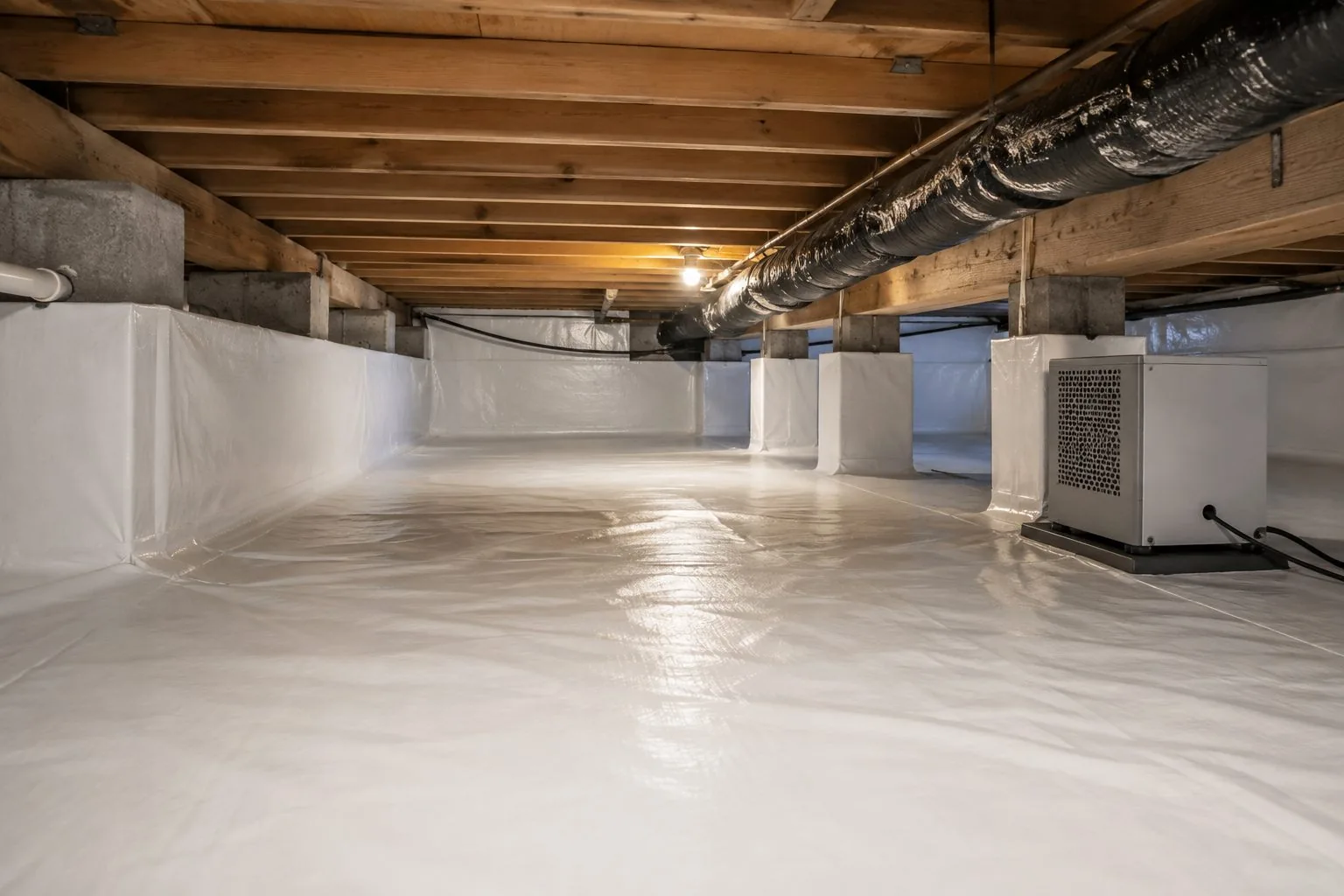
A 12–20 mil reinforced liner covers the entire floor and runs up the foundation walls, fully sealing the space from ground moisture.
Foundation vents are closed and insulated, and the access door is replaced with a sealed, insulated unit — stopping humid outside air from entering in the first place.
A crawl-space-rated dehumidifier maintains humidity in a safe range automatically, which is what actually stops mold from coming back after the initial cleanup.
Where standing water is a factor, a dedicated sump pump is set into the encapsulation system so ground water is captured and removed rather than trapped under the new barrier.
A full encapsulation — vapor barrier, sealed vents, insulated door, and dehumidifier — for an average Central Indiana crawl space typically runs $4,500–$9,000. Adding a dedicated sump pump or structural repairs increases the range. No pressure, no upsell — just an honest read on what your home actually needs.
We'll call to confirm a time \u2014 usually within one business day.