A wet basement isn't a one-time bad storm — it's a system telling you it's about to happen again. Greenfield homes see this regularly, largely for the same soil and drainage reasons common throughout Hancock County.
Greenfield's mix of historic downtown homes and newer Hancock County development east of Indianapolis gives us everything from century-old stone foundations to five-year-old crawl spaces needing their first encapsulation. You'll find our crews working around Downtown Greenfield and Brandywine Creek area on a normal week, along with the rest of Hancock County.
What we see most in Greenfield traces back to the ground under it — a mix of century-old settled soil downtown and newer Hancock County fill on the outskirts — paired with a wide span of housing ages, which means a wide span of causes. That's a common thread in the basement waterproofing calls we take from the Brandywine Creek area out across Hancock County. We see it steadily in Greenfield, alongside Crawl Space Encapsulation, which fits the area's everything from decades-old homes to recent builds, side by side.
Access in Greenfield depends on which part of town — established neighborhoods versus newer development — but neither slows down a properly scoped job.
Standing water or damp spots on the basement floor after rain
A white, chalky mineral residue (efflorescence) on the walls
Musty smell that doesn't go away with normal cleaning
Peeling paint or a soft, crumbly texture on painted block walls
Rust on the bottom of stored metal items or corrosion on the water heater base
A sump pump that runs constantly, or one that's never been tested
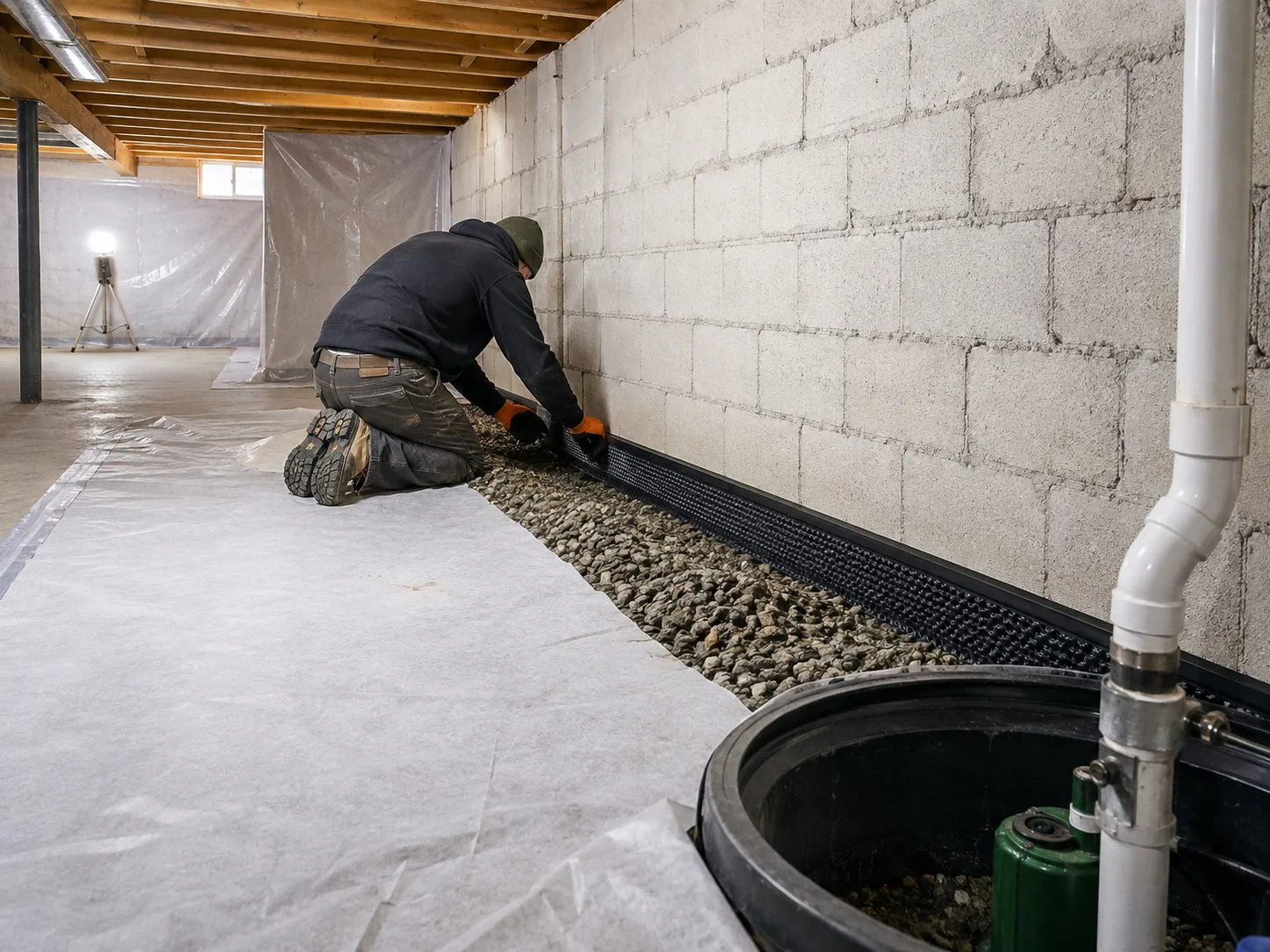
A drainage channel is cut along the base of the basement walls, capturing water before it reaches the floor and routing it to a sump pump. This is the most common and most cost-effective fix for cove joint leaks.
The engine of any interior system. We install primary pumps sized to your basement's actual water volume, plus a battery backup so a storm-related power outage doesn't undo the whole system.
A dimpled plastic membrane installed against block or poured walls to intercept seepage and direct it down to the drain system, rather than letting it wick through the wall surface.
For homes with active exterior work already planned, or in specific cases where interior systems aren't viable, we excavate to the footing and apply a waterproof membrane and drainage board directly to the foundation wall.
Interior systems for a typical basement usually run $3,000–$8,000. Full exterior excavation and membrane work runs considerably higher, often $7,000–$18,000+ depending on dig depth and yard restoration. Get a straight answer, in writing, before you spend anything.
We'll call to confirm a time \u2014 usually within one business day.