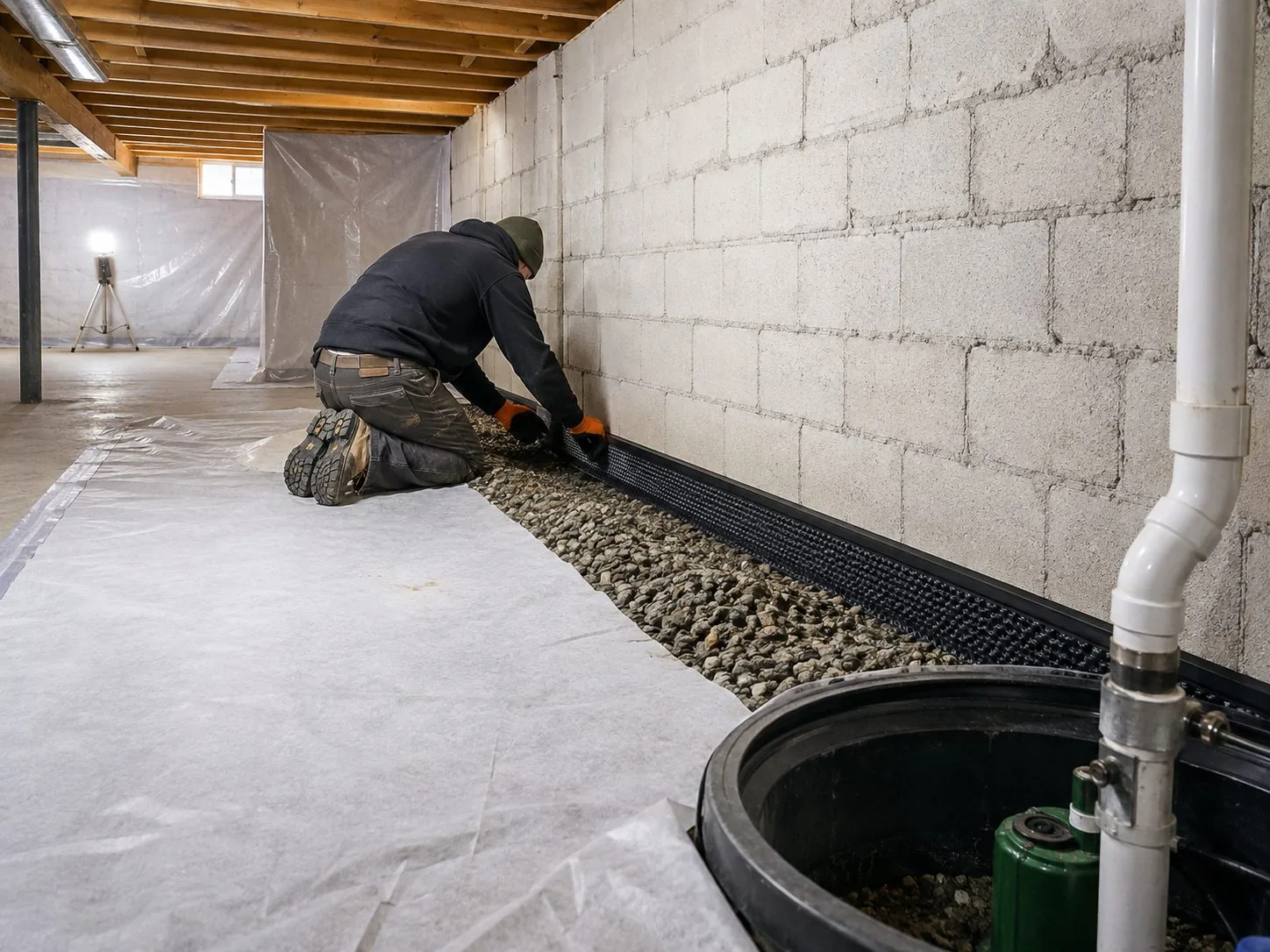
Illustrative image; not a verified customer project.
Before winter, identify where the sump discharge exits and where water goes from there. Look from safe ground for obstructions, disconnected fittings and water returning toward the foundation. Ask the installer how the route handles freezing conditions. Do not alter a pipe, bypass a safety feature or enter water near electrical equipment to test it.
Follow the discharge route on paper first
Start with the system documents or ask the installer to point out the inside pipe, exterior exit and final discharge point. An underground route may not be obvious from the wall fitting. Sketch what you can identify and mark the parts you cannot see.
A pump's operation and its discharge route are different checks. Hearing the motor run does not establish that water reached its intended destination. Our sump-pump test guide discusses a basic cycle check; use the manufacturer's instructions and stop if access or electrical conditions are unsafe.
What to observe outdoors before cold weather
- Identify the visible outlet and whether leaves, soil, stored items or snow could obstruct it.
- Photograph the pipe route and any low area where water collects.
- Note whether discharged water drains away or returns toward the wall.
- Check whether the route crosses a walkway or drains toward another property.
- Record fittings or accessories so the installer can identify their intended function.
Do not remove a fitting simply because it looks unusual. It may serve a specific drainage, venting or cold-weather purpose. Ask for the product name and its maintenance instructions.
Questions for the installer about freezing
Ask how the actual system handles water left in exposed pipe, what parts must remain unobstructed, and what observations should prompt a service call. Bring the model information and photos. There is no universal DIY pipe layout that works for every pump, elevation and discharge destination.
| Question | Why it helps |
|---|---|
| What is the final destination? | A visible pipe exit may only be the start of the route. |
| Which parts need inspection in winter? | You need a safe, practical access plan. |
| What happens if the route is obstructed? | You need a response plan before a failure. |
| Are accessories approved for this system? | A generic fitting may not suit the installed equipment. |
| Who confirms local drainage requirements? | Acceptable discharge depends on the address and destination. |
Keep drainage and backup-power decisions separate
A backup pump or battery may address an outage or an equipment failure. It cannot be assumed to overcome an obstructed shared discharge route. Ask what components the primary and backup systems share, and what the alarm tells you when a problem occurs.
Read backup-pump planning with the pipe layout beside you. Keep the maintenance instructions for both systems together.
Do not move the water problem elsewhere
Before changing a discharge destination, check with the local authority and a qualified installer. Do not assume that a sanitary sewer, street, sidewalk, drainage easement or neighboring yard is an acceptable outlet. This checklist makes no permit or code determination for your property.
The University of Minnesota Extension's basement moisture guide explains why water-management paths should be considered as a system. Use the sump installation overview to organize the equipment and drainage questions together.
If the pump runs but water is rising
Stay out of standing water near electrical equipment. Seek qualified help rather than dismantling piping during an active incident. When you request a sump-system callback, report whether the pump runs, where water is rising, what alarms sound and what you can safely observe outside. The inquiry form is not an emergency dispatch service.