The pump that's supposed to protect your basement is only as good as the day it was last tested. If you're dealing with this in Westfield, you're not looking at a rare problem — it's one of the most common calls we get in Hamilton County.
Westfield's newer subdivisions sit on Hamilton County clay that hasn't fully settled the way older lots have, which is why we see more early-stage crack and drainage calls here than deep-settlement repairs. Grand Park area and Wood Wind are areas we're in often, along with the broader Hamilton County.
In Westfield, the driver is usually the ground itself: recently disturbed clay fill that's still compacting under newer construction. Combined with recently built homes where the soil hasn't fully settled yet, that's the pattern behind most of the sump pump installation calls we run near the Grand Park area and the rest of Hamilton County. We see it steadily in Westfield, alongside Crack Repair, which fits the area's a housing stock young enough that original grading is still the main variable.
Westfield's newer subdivisions are typically easy to schedule around — open yards, recent grading records, and straightforward access.
No sump pump in a basement that's below the water table or has a history of dampness
A pump that hasn't been tested in over a year
Rust, corrosion, or a cracked basin around your existing pump
A pump that runs constantly even without recent rain
No battery backup on a home that's lost power during a storm before
A discharge line that empties too close to the foundation, sending water right back
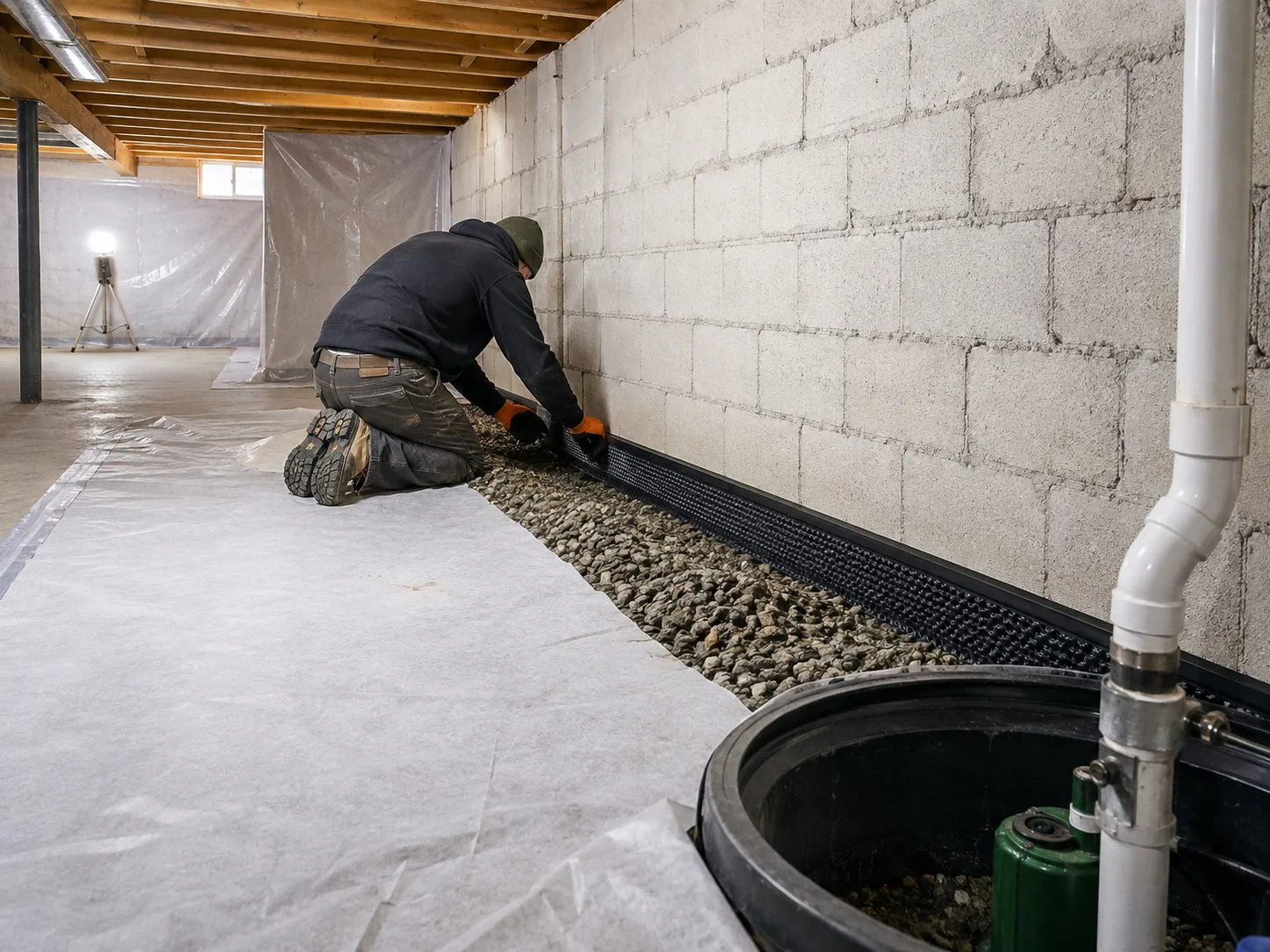
Properly sized submersible pump set in a new or existing basin, with a check valve and correctly routed discharge line that carries water well away from the foundation.
A second pump powered by a dedicated battery, activating automatically if the primary pump fails or the power goes out — exactly the scenario that causes most preventable basement flooding.
For homes with reliable municipal water pressure, a water-powered backup pump runs off your water line with no battery to maintain, as a second layer alongside the primary pump.
For basements with a history of heavy water or a large drainage area feeding the basin, dual primary pumps handle volume that a single pump can't keep up with.
A standard primary pump install typically runs $650–$1,800. Adding a battery backup system brings most installs to $1,500–$3,200. Get a straight answer, in writing, before you spend anything.
We'll call to confirm a time \u2014 usually within one business day.