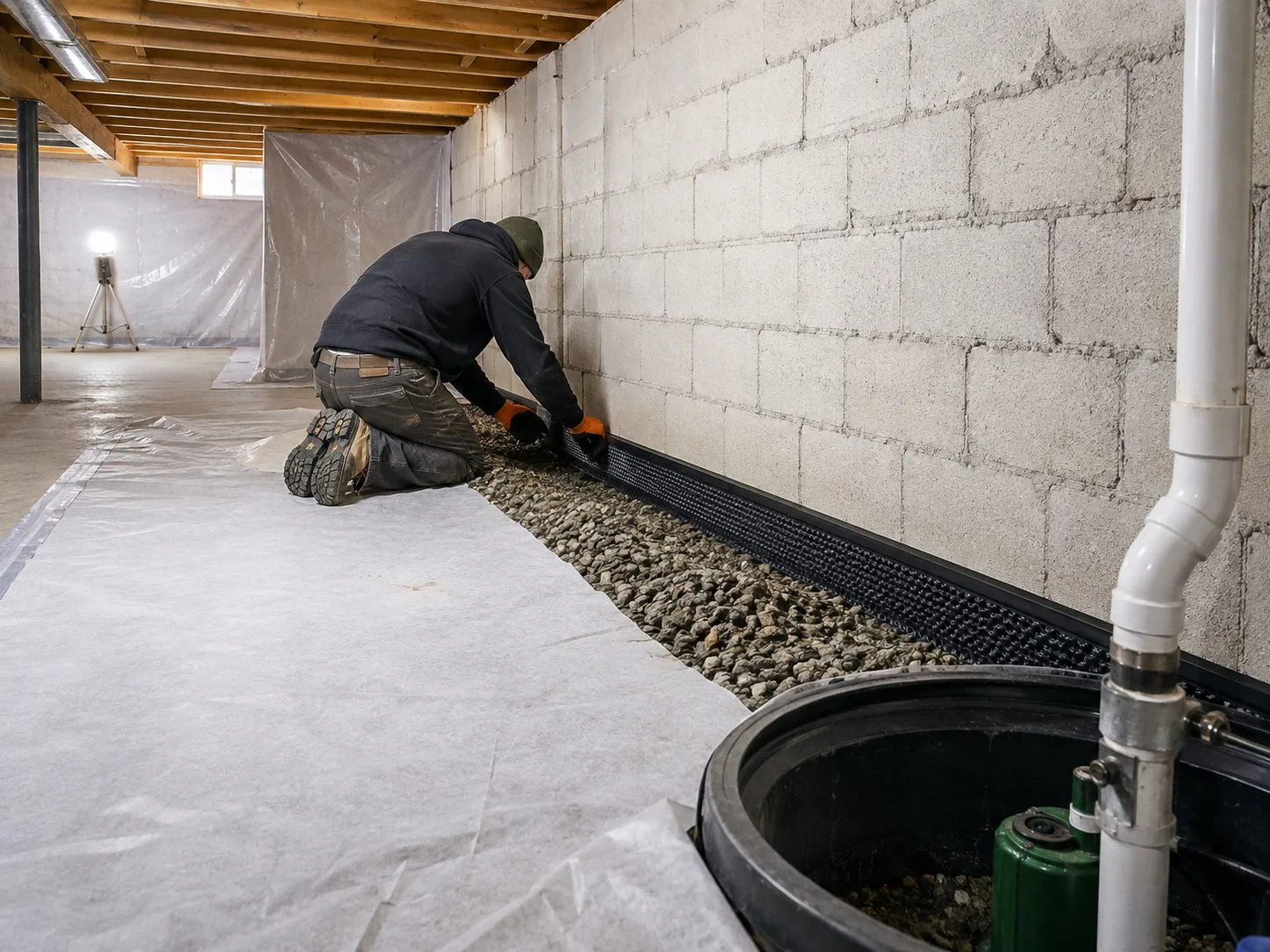
The pump that's supposed to protect your basement is only as good as the day it was last tested. Homeowners in Whitestown run into this more than they'd expect, and it tracks closely with what we see across Boone County.
Whitestown is one of the fastest-growing towns in the state, and most of the foundation work we do here is on homes under fifteen years old — usually drainage or early settlement, not structural failure. We regularly work near Anson and Newport Village, and across the rest of Boone County.
What we see most in Whitestown traces back to the ground under it — some of the newest compacted fill soil in the metro, still settling under recent construction — paired with mostly newer construction still working through its first years of settling. That's a common thread in the sump pump installation calls we take from the Anson development out across Boone County. It's a regular call here, though Crack Repair tends to come up just as often given Whitestown's mostly newer construction still working through its first years of settling.
Newer Whitestown lots are generally straightforward for crews to access, with less mature landscaping in the way than older neighborhoods see.
No sump pump in a basement that's below the water table or has a history of dampness
A pump that hasn't been tested in over a year
Rust, corrosion, or a cracked basin around your existing pump
A pump that runs constantly even without recent rain
No battery backup on a home that's lost power during a storm before
A discharge line that empties too close to the foundation, sending water right back
Properly sized submersible pump set in a new or existing basin, with a check valve and correctly routed discharge line that carries water well away from the foundation.
A second pump powered by a dedicated battery, activating automatically if the primary pump fails or the power goes out — exactly the scenario that causes most preventable basement flooding.
For homes with reliable municipal water pressure, a water-powered backup pump runs off your water line with no battery to maintain, as a second layer alongside the primary pump.
For basements with a history of heavy water or a large drainage area feeding the basin, dual primary pumps handle volume that a single pump can't keep up with.
A standard primary pump install typically runs $650–$1,800. Adding a battery backup system brings most installs to $1,500–$3,200. No pressure, no upsell — just an honest read on what your home actually needs.
We'll call to confirm a time \u2014 usually within one business day.